
Why Player Counts Matter: Comparing Sports Game Popularity to Real-World Viewership
By Alex╺
- PS4
- PS5
- XBox One
- Series X
- PC
Two numbers dominate how we talk about popularity. In gaming, it’s the player count. In sports, it’s the viewership figure.
Both get quoted constantly, and both get misread just as often. A game “loses half its players.” A championship “doubles its audience.” The headline sounds clear, but the number underneath is doing something more complicated than most people realize.
Sports games sit right in the middle of this. They’re games with player counts, based on a sport with viewership numbers. That makes them a useful test: does interest in the real thing show up in the digital one?
Let’s look at what each number actually measures, compare them using a real example, and talk about how to read them without getting fooled.
What a player count actually measures?
When you see a player count on a site like PlayerCounter, you’re almost always looking at concurrent players: how many people are in the game at the same moment. Two figures show up most often.
- Peak concurrent players. The highest number online at one time during a day, month or the game’s whole life. It’s a snapshot of the busiest moment.
- Average concurrent players. The typical number online across a period. It says more about steady interest than a single spike.
There’s a catch that matters a lot for sports games. Most public counters track Steam only. That leaves out PlayStation, Xbox and Nintendo players, who make up a big share of an audience for a game like a basketball sim. So the number is a useful signal, not a headcount.
What viewership actually measures?
Viewership is usually reported as an average audience: the typical number of people watching during a broadcast, measured by a firm like Nielsen.
Networks also quote peak audience, which captures the most-watched minute, plus share, which compares the broadcast to everything else being watched at the time.
Measurement itself changes. Nielsen’s newer Big Data + Panel method, which media outlets note tends to lift live sports audiences compared with earlier years, means year-over-year comparisons carry an asterisk. Bigger numbers can partly reflect a better yardstick, not only more fans.
A real comparison: the 2026 NBA season
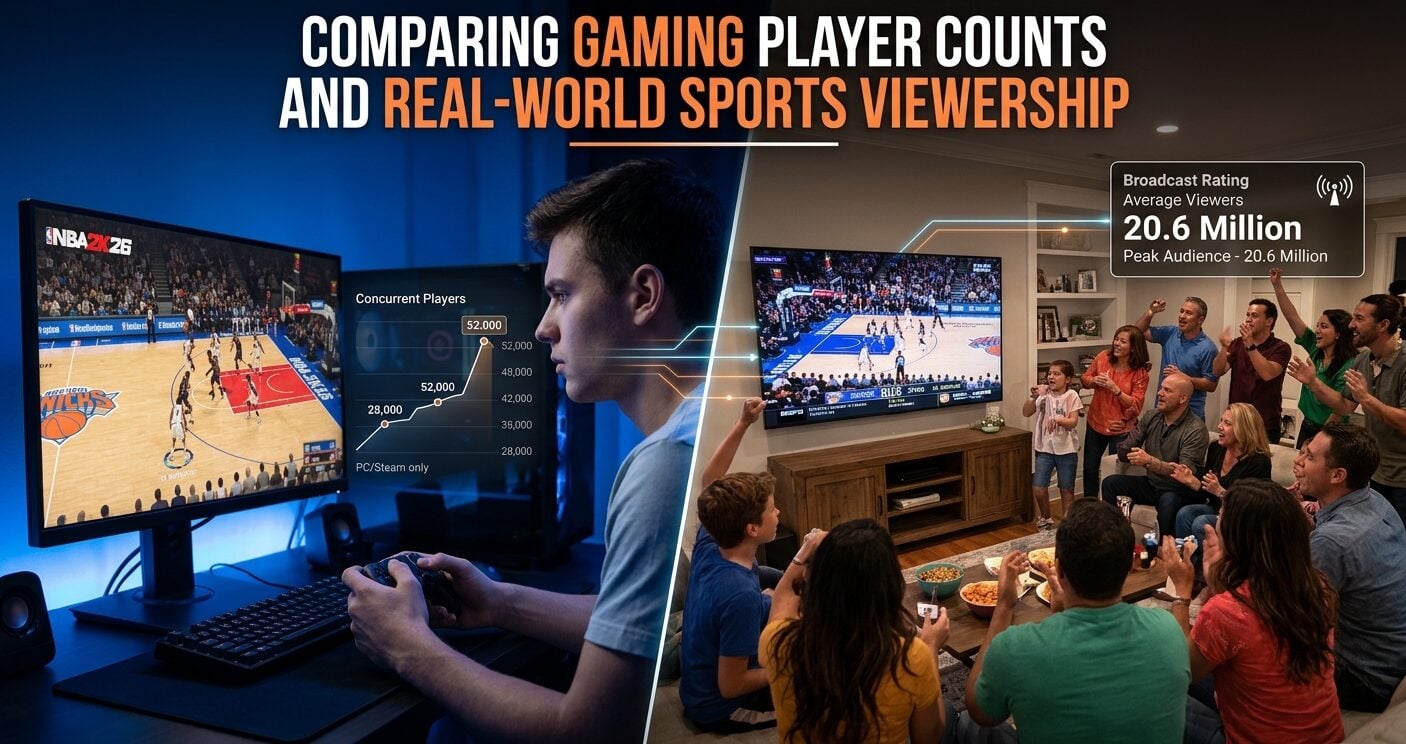
The 2026 NBA Finals make a good test. According to the NBA’s own release, the Knicks-Spurs series was the most-watched Finals since 1998, averaging 20.6 million viewers on ABC and ESPN. The league also reported its most-watched postseason in 28 years, a record 38.3 share for the Finals and 15 billion social media views.
Now look at the game. SteamCharts’ monthly figures for NBA 2K26 show a game that climbed through the season. Average concurrent players were around 11,700 in October 2025, the first full month after launch, and about 19,000 by January. They reached roughly 28,000 in May 2026, when the game also hit its all-time Steam peak of 52,826.
At first glance that looks like the real sport lifting the virtual one. The playoffs ran through those months, interest in basketball was high, and the player count rose with it.
But look closer. The count peaked in May, not during the Finals in June. Average players slipped back to about 26,100 in June, even while TV audiences were at their highest. If viewership were driving player count directly, the two would peak together. They didn’t.
Why the two numbers don’t line up perfectly?
There are several reasons the real-world audience and the player base drift apart:
- Different units. One counts people online at one instant. The other counts the average audience across a broadcast. They’re not the same kind of number.
- Passive versus active. Watching a Finals game takes nothing but a TV. Playing takes a purchase, a console or PC and your time.
- Game updates. Seasonal content, events and patches move player counts regardless of what’s happening in the league.
- Platform coverage. A Steam counter can’t see console players, so shifts between platforms look like changes in popularity.
- Annual release cycles. Sports games get replaced every year, which creates built-in decay as players move on to the new version.
That last one is happening right now. NBA 2K27 launched on September 4, so NBA 2K26’s player base is naturally moving to the new game. A drop in the older title doesn’t mean basketball got less popular. It means a newer version arrived.
What player counts tell you that viewership can’t?
Viewership measures reach. Player counts measure commitment.
Millions of people can watch a game they’ll never think about again. A player count shows who is willing to spend hours inside a game, week after week. That makes it a much better gauge of whether people like the product, not just the moment.
It also shows how a game ages. A big launch spike followed by a steep drop tells a different story than a slow, steady climb like the one NBA 2K26 showed. Publishers watch those curves closely because they predict long-term health.
What viewership tells you that player counts can’t?
Viewership shows the cultural size of the sport itself. Few games, in any genre, get close to the audience a major championship pulls in.
It also captures casual fans who never touch a controller. A person who watches the Finals with family and checks scores the next day counts as a fan, but won’t show up on any player chart. That matters when you’re comparing the size of a game’s audience to the size of the sport’s.
How to read these numbers without being fooled?
A few habits make you a more reliable reader of either statistic:
- Compare like with like. Peak to peak, average to average, same time window.
- Check platform coverage. If a number is Steam-only, treat it as a trend, not a total.
- Look at the average, not just the peak. Peaks are exciting. Averages are honest.
- Account for release timing. Launch weeks and annual replacements distort everything around them.
- Watch for measurement changes. New ratings methods or new tracking tools can shift numbers without the audience changing.
- Remember correlation is not causation. Two lines rising together doesn’t prove one caused the other.
Following both sides of the story
If you like comparing these numbers, it helps to follow the sport as well as the charts. The player count tells you what gamers are doing.
The real-world season explains why. Daily coverage from places like Basketballloop makes it easier to connect a viewership spike to the series, star or storyline behind it.
What to watch next?
The cleanest test of all is happening now. NBA 2K27 is the new release, and it will give you a fresh set of numbers to compare against NBA 2K26. SteamCharts lists NBA 2K26’s launch month peak at 31,973 concurrent players in September 2025, which gives you a baseline.
Watch three things as the season goes on:
- Launch month. How does the new game’s first-month peak compare with last year’s?
- The middle of the season. Does the count hold steady, or does it fall away once the novelty fades?
- The playoffs. Does the player base rise again as real-world interest peaks, like it did this year?
If the pattern repeats, you’ll have decent evidence that the sport and the game really do move together. If it doesn’t, you’ll know the story is more about the game’s own updates and cycles than about real basketball.
The takeaway
Player counts and viewership numbers answer different questions. One tells you how many people are watching. The other tells you how many are playing, and for how long.
Neither is the whole truth, but together they’re a lot more useful than either alone. The next time you see a bold headline about a game “dying” or a broadcast “breaking records,” ask what exactly was counted, over what period, and on which platform. That one habit will put you ahead of most of the people quoting the number.
