
Why Two CS2 Knives with the Same Name Can Look Completely Different
By Alex╺
- PS4
- PS5
- XBox One
- Series X
- PC
When looking at CS2 knives, you may notice that two knives with the same name can have very different appearances. The model might be the same, but the finish, pattern, or condition can change how it looks.
These details also explain why knives are so expensive in some cases and fairly affordable in others. Let’s look at why these differences occur and what to pay attention to when comparing knives.
How Knife Finishes Change Their Appearance?
The finish can make a big difference in how a knife looks. StatTrak versions add one more visible detail, a kill counter on the blade, but the finish has a much bigger effect. Here, we’ll look at the different finishes available and how they affect the appearance of a knife.
Camo Finishes Keep the Knife Simple
Camo finishes like Safari Mesh, Boreal Forest, Forest DDPAT, and Urban Masked use dull, military-style colors. They’re usually the cheapest way to get a knife model. A Karambit | Safari Mesh, for example, starts at around $380. A plain “Vanilla” knife with no paint is different, though.
It isn’t always cheap. The Vanilla Butterfly Knife is one of the most expensive Butterfly items, because a lot of players like how the clean steel looks on that model.
Patterns Make Each Copy Different
Some finishes look different on every knife because of the pattern. On Case Hardened, the pattern decides how much blue and gold ends up on the blade. A normal Karambit | Case Hardened in Field-Tested costs around $700, but copies with lots of blue, called “blue gems,” can sell for tens of thousands of dollars.
Fade works in a similar way, since the pattern decides how far the color gradient spreads. On Crimson Web, the pattern changes where the web lines sit on the blade.
Doppler Phases Change the Color
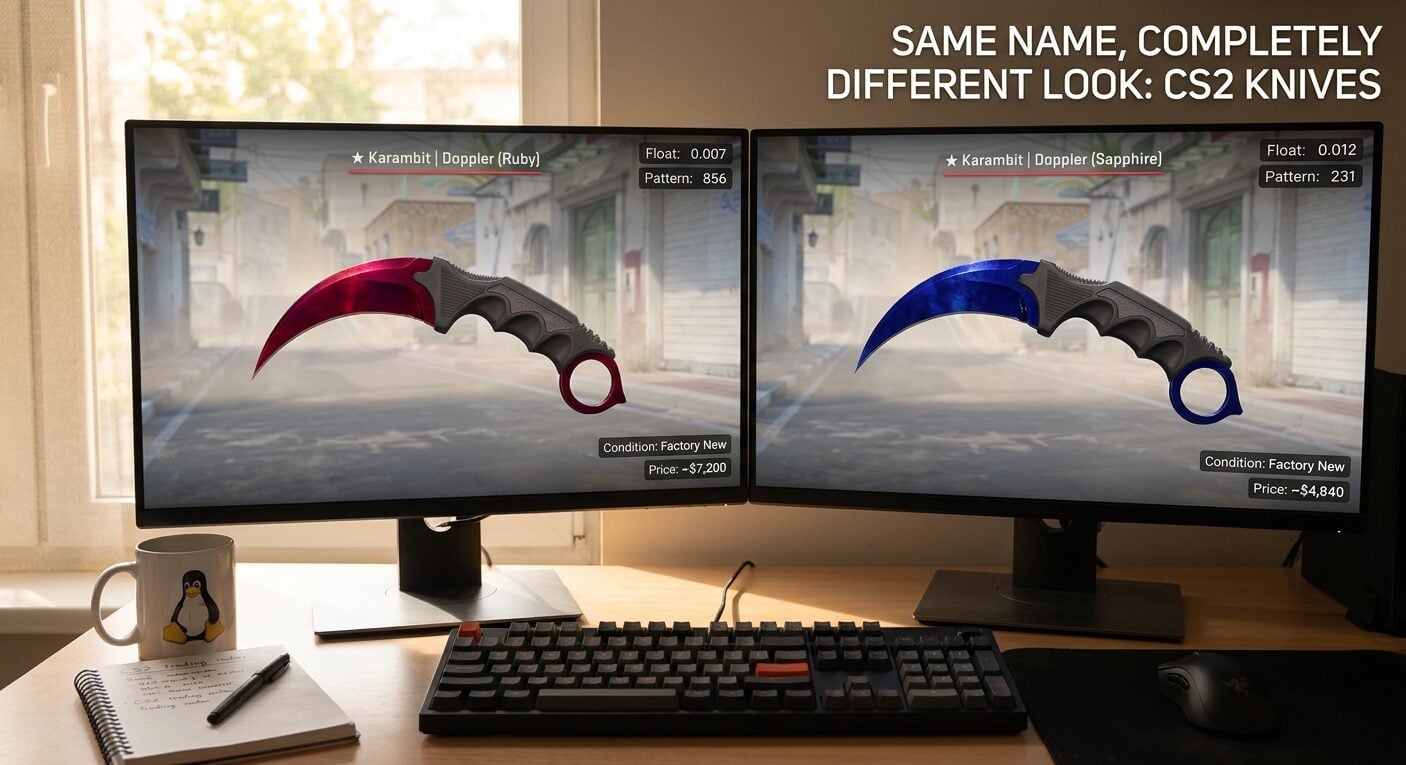
Doppler knives come in phases, and each one looks different. Phase 1 to Phase 4 each mix the colors in their own way, while the rare phases stand out more. Ruby is red, Sapphire is blue, and Black Pearl has much darker tones. Gamma Doppler is the green version, and its rarest phase is Emerald.
The phase has a big effect on price. A Karambit | Doppler Phase 2 starts at around $1,800, while a Ruby on the same knife starts at around $7,200.
How Wear Condition Affects a Knife?
The condition of a knife can also affect its appearance. In this section, we’ll look at the different wear levels and how they change the look of a knife.
A Lower Float Means a Cleaner Knife
How worn a knife looks depends on its float. Factory New is 0.00 to 0.07, Minimal Wear is 0.07 to 0.15, Field-Tested is 0.15 to 0.38, Well-Worn is 0.38 to 0.45, and Battle-Scarred is 0.45 to 1.00. Lower floats look cleaner and usually cost more.
The Karambit | Case Hardened shows this well. A Factory New copy costs around $1,770, Minimal Wear around $880, and Battle-Scarred around $620. Same knife, same finish, but the wear changes the price a lot.
Some Finishes Only Come in Two Wear Levels
Not every finish can be Battle-Scarred. Doppler knives and the Butterfly Knife | Fade, for example, have a float range of only 0.00 to 0.08. This means they can only be Factory New or Minimal Wear, which is why they almost always look clean and shiny.
It also means the price gap between the two wears can be very small. A Butterfly Knife | Fade costs about the same in Factory New and Minimal Wear, both at around $2,250, since the difference is barely visible.
Small Wear Differences Can Be Hard to See
A knife with a float just over 0.07 counts as Minimal Wear, but in game it can look almost the same as Factory New. The same thing happens with a Field-Tested knife close to 0.15. Because of this, two knives in different wear levels can look nearly identical but have very different prices. On the other hand, some finishes lose a lot of their design once scratches appear.
Inspecting the exact knife in game is the best way to see how much the wear actually shows, especially with CS2’s new lighting, which can make scratches and colors look different than they did in CS:GO.
Three Knives with the Same Name That Look Different
Let’s take a look at three examples and see how their finishes, patterns, or wear conditions change their appearance.
Karambit | Doppler
Two knives called Karambit | Doppler can look nothing alike. A regular phase mixes several colors, a Ruby is almost fully red, and a Sapphire is a deep blue. They use the same model and the same float range, so the phase is the only real difference.
But that difference is huge. In June 2026, a Factory New Ruby sold for around $8,760, while a Factory New Sapphire was around $4,840. A Phase 2 copy starts at about $1,800, a fraction of either one.
Karambit | Case Hardened
With the Karambit | Case Hardened, the pattern number decides the colors. Most copies are mostly yellow and gold, and those start at around $620 in Battle-Scarred. But some patterns are almost fully blue, and these are the “blue gems” players look for.
Pattern 387 is the most famous one for the Karambit, and the best blue gems can reach tens of thousands of dollars. The pattern isn’t shown in the name, so buyers check it in game before paying.
Butterfly Knife | Fade
The Butterfly Knife | Fade first came out in 2014 with the Operation Breakout Case. Its colors blend from yellow to pink and purple, but the pattern decides how far the colors spread. Players call this the fade percentage. A copy with more pink and purple across the blade usually costs more than one with more yellow.
Regular copies start at around $2,250, but near-100% fades sell for much more. Since the fade isn’t in the name, buyers often check it with fade calculators or with CS2 fade checkers.
Conclusion
In conclusion, two knives with the same name can look different depending on their finish, pattern, and wear condition. These details affect both a knife’s appearance and price, so compare them carefully before buying.
