
Why Player Counts Can Make Dead Games Look Alive and Small Games Look Bigger Than They Are
By Alex╺
- PS4
- PS5
- XBox One
- Series X
- PC
A lot of attention gets paid to player counts these days, particularly in the period immediately following the launch of a new title, when everyone’s flocking to Steam to see how well it’s faring and whether the marketing hype has translated into an experience people actually want to stick around and enjoy for more than an hour or two.

At the other end of the spectrum, player counts can provide insights into games that are on their last legs, perhaps having fallen from grace and gone from having tens of thousands of active players to just a few hundred.
What’s surprising is that the player count of a given game doesn’t necessarily correlate with how ‘alive’ it feels. A game that sounds dead on paper, with just a handful of active participants, might actually be a blast to play, while small games might have the illusion of ‘bigness’ by dint of a player count that’s easy to misinterpret.
Dealing with the Dead or Alive Question
A game with only a few hundred concurrent players can feel vibrant and fast-moving if it has two specific design traits: high density and low friction. In a fighting game like Guilty Gear or a 1v1 strategy game, you only need one other person to play.
If a game has 500 active players, and matches last 5 minutes, 100 people are entering the matchmaking pool every single minute, and the queue moves instantly.
Likewise, games that abandon automated matchmaking in favor of old-school server browsers or public lobbies feel much larger than they are. When all 400 remaining players are packed into five or six custom rooms, the community feels tight-knit and active.
Then, there are single-player online experiences, like those available at the Slots of Vegas Casino and other iGaming sites. Here, player count is irrelevant, because you’re only engaging in the equivalent of PvE gameplay.
Contending with the Confusion of High Player Counts that Feel Dead
A game can have 20,000 concurrent players on Steam and still feel like a ghost town. This happens when those players are heavily fragmented, and is particularly common for battle royale-style games, because if the minimum requirement is 100 players per match, a pool of 5,000 concurrent players globally is dangerously small.
Once you split those 5,000 players by region and then by skill bracket, a single queue might have only a few dozen eligible players at any given moment, leading to 10-minute wait times.
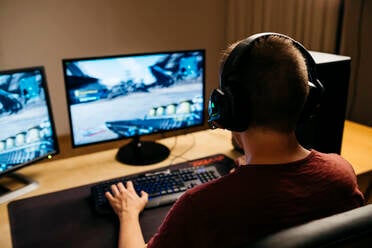
Similarly, modern multiplayer games often split their audience across too many modes, resulting in queue fragmentation.
If a shooter has Casual, Ranked, Team Deathmatch, Capture the Flag, and three rotating event modes, a healthy player count gets divided into tiny, isolated pockets.
Lastly, raw player counts track anyone who has the executable running. In many MMOs and strategy games, a large percentage of the ‘active’ population is actually AFK, managing inventory on menu screens or idling in private spaces, completely removed from the matchmaking pool.
So, there are a few obvious problems in how player counts are interpreted, because they don’t necessarily show you how popular a game really is, how fun it’ll be to play, or whether it’s teetering on the brink of obliteration. Knowing this helps you choose where to play.
