
What the Studio Logos in a Casino Lobby Reveal About the Casino’s Licence
By Alex╺
- PS4
- PS5
- XBox One
- Series X
- PC
Open almost any online casino, scroll past the welcome banner, and you will find a row of studio logos: Pragmatic Play, NetEnt, Hacksaw Gaming and a few dozen more. Most players treat the row as decoration. New data suggests the row works more like a fingerprint, because licensed and offshore casinos are stocked by noticeably different game studios.
The figures come from a census of which game studios supply licensed and offshore casinos, published by the Kasinohai Research team on 31 July 2026. The team recorded 320,187 links between casino brands and the 353 studios supplying them.
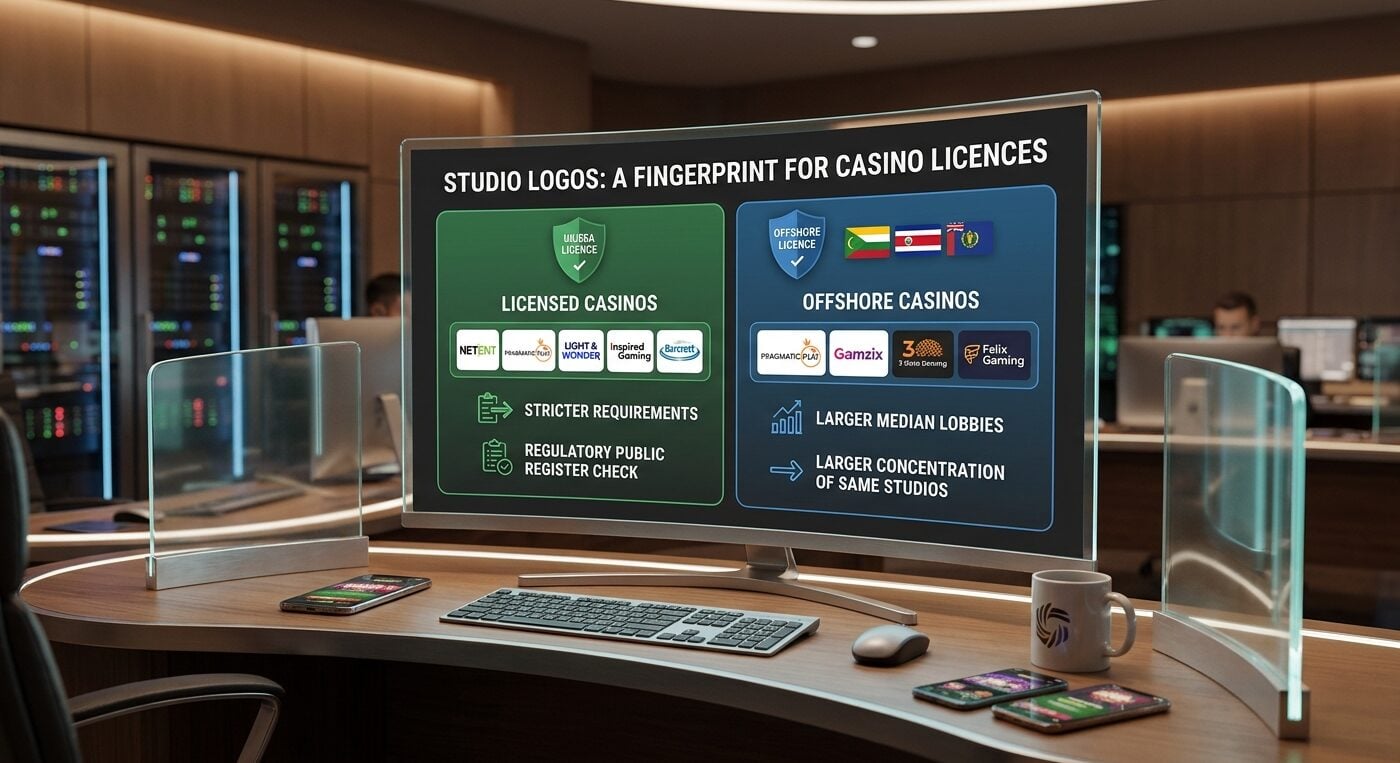
A licensed brand holds a national gambling licence from the UK or a European Economic Area country; an offshore brand is licensed in Anjouan, Costa Rica or Tobique instead.
The sample holds 1,121 licensed brands and 420 offshore brands. Brands with both kinds of licence, or neither, were left out; most of those excluded brands are licensed in Curaçao.
Licensed and Offshore Casinos Stock Different Studios
The study sums up the gap in one figure: 43.5% of all studio-to-casino links would have to move before the two groups carried the same mix of studios.
A score of 0% would mean identical lobbies, and 100% would mean no studio in common. Adjusting for catalogue size barely changed the score (42.9%), and counting one brand per operator still left 36.2%.
The biggest studios do work on both sides. NetEnt appears at 86.8% of licensed brands and 78.8% of offshore brands, Pragmatic Play at 78.4% and 95%, and Hacksaw Gaming at 56.7% and 92.1%. A lobby built mostly from those three names says very little about where the casino is licensed.
Which Studios Only Turn Up on One Side?
The logos worth reading sit further down the row. Inspired Gaming appears at 44.2% of licensed brands and 0.7% of offshore brands. Barcrest appears at 21.9% and 0.2%. Light & Wonder (16.9% of licensed brands) and Bet Digital (15.4%) do not appear at a single one of the 420 offshore brands.
Other studios run the opposite way. Gamzix games are found at 86% of offshore brands and 3.9% of licensed brands. 3 Oaks Gaming sits at 80% offshore and 3.8% licensed, and Felix Gaming at 72.4% offshore and 1.9% licensed.
Why Do Game Studios End Up on One Side?
Regulators no longer license only the casinos. As the report from Kasinohai sets out, Sweden has required game providers serving Swedish players to hold a licence since July 2023, and the UK requires a software licence from any studio supplying British players remotely, wherever the studio is based.
A recent UK case shows the cost of losing track of where games go. On 23 July 2026 the UK Gambling Commission announced that Evolution Malta Holding Limited would pay £4.75 million because Evolution games had been accessible to British players through six unlicensed websites.
John Pierce, the Commission’s Director of Enforcement, said suppliers “need to understand who they are supplying their games to.”
The study from Kasinohai stops short of naming one cause for the divide. The data cannot show whether studios turn offshore operators away, whether offshore operators cannot get access, or whether the two groups simply sign different commercial deals.
Why Do Offshore Casinos Have Bigger Game Lobbies?
The median offshore brand offers games from 72 studios, against 31 for the median licensed brand. The gap holds at the small end too: one in four licensed brands carries 16 studios or fewer, while the same cut-off for offshore brands is 49.
A bigger lobby is not a more varied one. On a typical offshore brand, 67.7% of the catalogue comes from studios found on nearly every offshore casino, compared with 24.2% on a licensed brand. Two offshore casinos picked at random share 54% of their studios; two licensed casinos share 37%.
The study also found no measurable link between lobby size and how many visitors a casino turns into registered players. Raw counts mislead in casino lobbies much as they do in games, a point PlayerCounter made in explaining why a player spike is not the same as player growth.
What the Studio Data Cannot Tell You?
The census records whether a studio’s games are present at a casino, not how often anyone plays them. Which titles players actually return to is a separate question, the kind PlayerCounter looked at for the most-played slots in Poland.
Studio names are also not companies. Light & Wonder, Barcrest, WMS and Bet Digital share a corporate parent, so several logos can lead back to one business.
Readers who want to know more about a studio than its logo can read this guide to casino game developers (in Finnish, on Kasinohai), which covers NetEnt, Pragmatic Play, Hacksaw Gaming and Light & Wonder among others.
For a player, the logos are a reasonable hint. A row heavy with Light & Wonder, Barcrest or Inspired Gaming titles points towards a licensed casino, while a row dominated by Gamzix, 3 Oaks Gaming and Felix Gaming points the other way. The reliable check is still the licence number in the casino’s footer, looked up on the regulator’s public register.
