
How Does ESL Pro League Season 24 Pick Each Team’s Next Opponent?
By Alex╺
- PS4
- PS5
- XBox One
- Series X
- PC
A team reaches 2-1 at ESL Pro League and finds another highly rated team waiting in its next match. Both have won twice, so why are they facing each other already? The answer starts with their records, then comes down to how the draw ranks the teams inside that group.

Season 24 brings 16 Counter-Strike 2 teams to Katowice for a Swiss group stage on October 3–7, 2026. Eight will advance to the playoffs at Spodek Arena on October 9–11, and every stage will be played in person.
ESL has confirmed that structure. Its detailed live-rating explanations come from earlier seasons, so the mechanics below describe Pro League’s established approach rather than confirmed Season 24 pairing rules.
Your record sets the pool
Swiss play gives a team several chances to qualify, with opponents changing as results come in. In recent Pro League editions, three series wins meant advancement and three losses meant elimination. A team could therefore finish in three matches or need all five rounds.
Under ESL’s published Pro League method, after the opening round, the eight winners enter the 1-0 pool and the eight losers enter the 0-1 pool.
Teams then face opponents with the same record, producing three groups after round two: 2-0, 1-1, and 0-2. Those numbers count series, not individual maps.
In that format, the fifth round leaves just six teams at 2-2. Three win their last series and qualify; the other three finish with a third loss.
That is why finishing a match does not necessarily reveal the next opponent. A team arriving at 1-1 must wait for a pool made up of winners from the 0-1 matches and losers from the 1-0 matches. The result of a series elsewhere can put a new name among its possible opponents.
If you follow the CS2 scores as they land, watch which teams are joining the same record group. A match going to a deciding map can leave that group incomplete, even when your team finished hours earlier. Once all the relevant series end, the draw can account for everyone in the pool and the opponents they have already faced.
Why equal records produce unequal opponents?
Two teams at 2-1 have achieved the same result, but the draw may rate their strength differently. Pro League’s live-rating system updates after each series, so results at the event can change the order between rounds. Beating a much stronger opponent can therefore alter where a team stands for the next draw.
A seed tells you a team’s position in that order; a rating also tells you how close it is to its neighbors. Seeds 1 and 2 might be almost indistinguishable on ratings, while a larger gap separates seeds 2 and 3. Treating every step in the ranking as equal loses that information.
ESL’s published live-rating method starts with the pool’s average rating. Each team’s ideal opponent sits equally far from that average in the opposite direction. Broadly, that steers stronger teams toward weaker teams within the same record group.
The calculation considers the whole set of matches together. It squares each gap between an ideal opponent’s rating and the actual opponent’s rating, adds the results, and chooses the lowest total. Squaring makes one large mismatch count more heavily than several small ones, while any arrangement containing a rematch is excluded.
Why seed 6 can face seed 1?
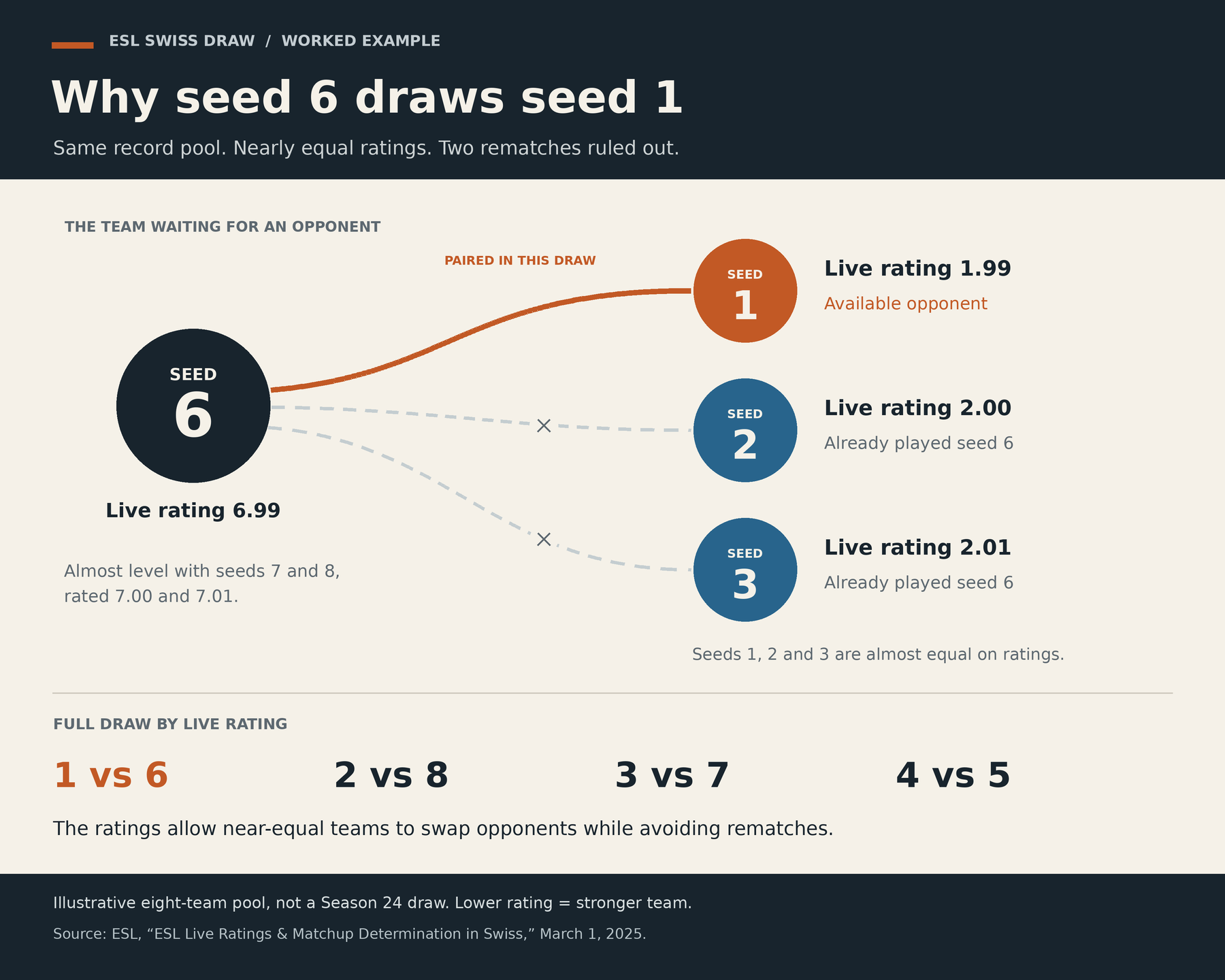
ESL’s eight-team example makes the effect easier to see. Seeds 1, 2, and 3 have ratings of 1.99, 2.00, and 2.01, while seeds 6, 7, and 8 sit at 6.99, 7.00, and 7.01. Lower numbers mean stronger teams in this example, so each trio is closely matched internally.
The complication is that seed 6 has already played seeds 2 and 3. Using seed positions alone, ESL’s example produces 1 vs 8, 2 vs 7, 3 vs 5, and 4 vs 6. Using the actual ratings produces 1 vs 6, 2 vs 8, 3 vs 7, and 4 vs 5.
Seed 1 still faces someone almost level with seeds 7 and 8, while seed 6 avoids both of its previous opponents. The three strongest teams each meet one of the three weakest, leaving the middle pair together. These are illustrative ratings, not a Season 24 draw.
This differs from the matchmaking familiar to online players, which often seeks opponents of similar skill while considering connection quality and waiting time.
Pro League has already grouped teams by results. Its published method then looks across that group’s ratings to arrange the matches, rather than simply putting the closest-rated teams together.
What is confirmed for Season 24?
ESL’s Season 24 announcement names the first monthly September 2026 Valve Regional Standings publication as the seeding reference and says Pro League will retain a seeding variation.
Earlier editions opened with pairings such as 1 vs 16 and 2 vs 15, then used live ratings between Swiss rounds, but ESL has not yet confirmed that Season 24 will use the same pairing process unchanged.
What is confirmed is the route through Katowice: best-of-three group matches, followed by an eight-team single-elimination playoff. The quarterfinals, semifinals, and third-place decider are best-of-three; the final is best-of-five.
When assessing a Swiss matchup, start with the other teams on the same record, then check their ratings and previous opponents.
Under ESL’s previously published method, a difficult pairing can follow directly from those constraints. Winning moves a team closer to qualification, but it does not promise an easier opponent next.
