
How Thousands of CS2 Players Turn Cheap Drops Into Knives and Gloves
By Alex╺
- PS4
- PS5
- XBox One
- Series X
- PC
Counter-Strike 2 sits near the top of Steam’s charts most weeks, and the scale behind that is hard to ignore. At its highest point the game has pushed past 1.8 million concurrent players, with monthly averages sitting close to the million mark.
Thousands of those players collect items every day, whether they care about them or not. Drops arrive after matches, cases gather in inventories, and the overwhelming majority of it is worth pennies.
That gap between what players own and what they actually want is the engine of the entire skin economy. It also explains why one particular mechanic gets more attention than almost anything else in the game.
Why Most Drops Are Worth Almost Nothing?
Rarity in CS2 works like a pyramid. Consumer, Industrial and Mil-Spec items fill the bottom and arrive constantly, while Covert skins, knives and gloves sit at the narrow top and show up rarely enough to hold real value.
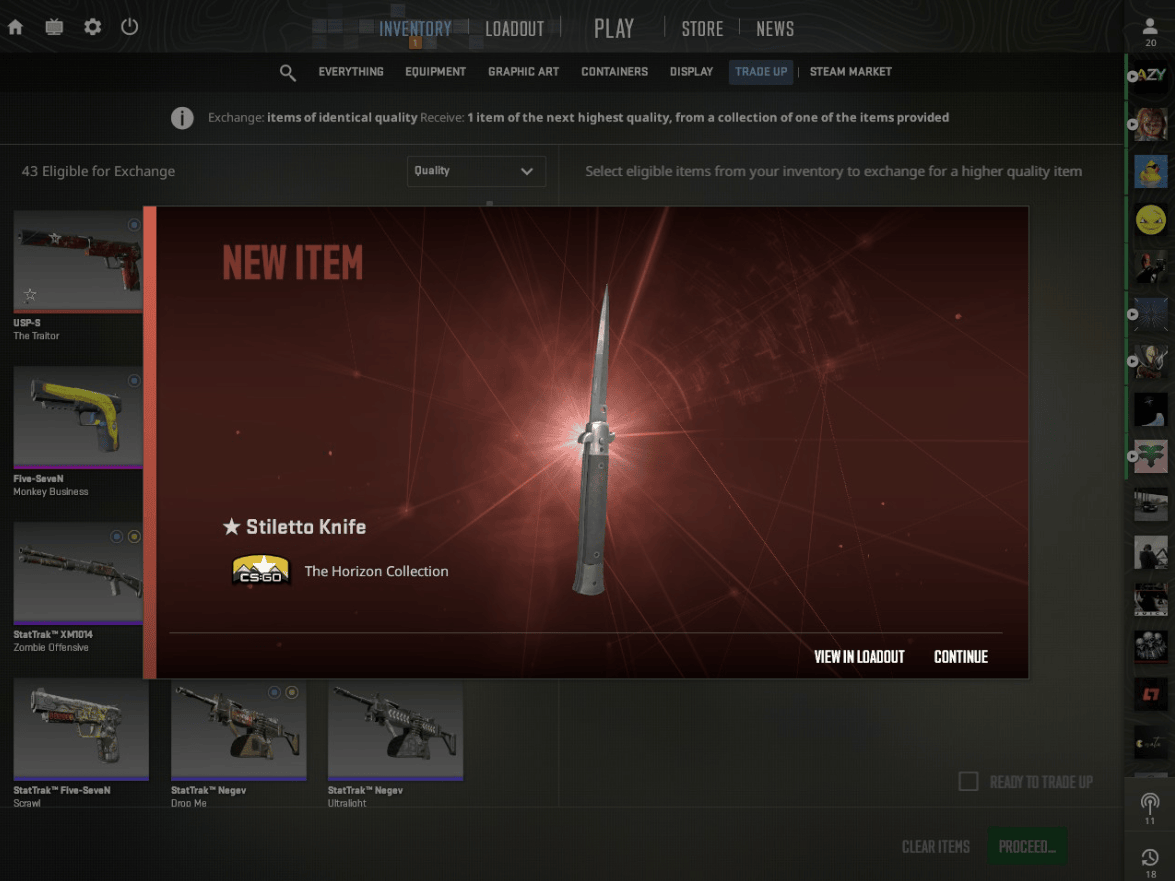
Trade-up contracts are the official route between those two ends. Ten skins of the same rarity go in, one skin of the next tier up comes out, and the odds depend entirely on which collections the inputs were pulled from.
The maths is not intuitive, which is why most players model a contract before committing anything to it. A CS2 trade up calculator lets you build the ten-item contract skin by skin, then shows the percentage chance of each possible output alongside the expected value of the whole thing.
That matters because a contract can look generous and still lose money. Each input acts as one ticket in a weighted draw for the collection, so nine skins from a cheap collection and one from an expensive one produces a very different distribution than an even split.
Seeing expected profit next to the actual cost of the inputs is what turns a guess into a decision. Running a simulated thousand contracts on the same inputs makes the spread obvious too, since a single favourable outcome says nothing about what the contract returns over time.
None of that guarantees a good result, and it is not meant to. What it does is replace a vague sense that a contract looks worthwhile with a number you can argue with before ten skins disappear from your inventory.
The Update That Rewired the Contract
For most of the game’s history, knives and gloves came from cases and nowhere else. That changed in October 2025, when Valve extended contracts so that five Covert items could be exchanged for a knife or a pair of gloves, with StatTrak inputs producing StatTrak knives.
The effect on the skins market was immediate. Roughly 1.75 billion dollars in value fell out of CS2 items almost overnight as knife prices dropped and several Covert skins climbed, and reaction split neatly between collectors watching their holdings shrink and ordinary players who suddenly had a realistic path to a knife.
For anyone sitting on a stack of Coverts, the question stopped being whether a knife was affordable. It became which five items to feed into the contract, and what the resulting item was likely to be worth.
Float Values Make It Harder Than It Looks
Wear is the part players most often get wrong. Every skin carries a float value that determines its condition, and a contract averages the floats of its inputs before mapping the result into the output skin’s own wear range.
Two contracts with identical odds can therefore produce outputs worth very different amounts. Feeding in a cheap Battle-Scarred skin to save a few cents will drag the output’s condition down with it, which is exactly how a technically profitable contract ends up disappointing.
Projecting that output float in advance is fiddly to do by hand, and it is the calculation that separates a considered contract from a hopeful one.
Collections complicate it further, because each one has its own set of possible outputs at every tier. A contract built from a single collection is predictable, while a mixed one trades that certainty for a shot at something better.
A Population That Keeps the Market Moving
None of this works without volume, and this is where the size of the player base does the heavy lifting. The live CS2 player count shows a game averaging close to a million concurrent players, with an all-time peak of 1,818,368 recorded in March 2025.
More players means more drops entering circulation every week, which keeps low-tier inputs cheap and plentiful. Contracts only make sense while the bottom of the pyramid stays oversupplied, and a game this size guarantees that it does.
It also means liquidity at the top. A knife or a Covert skin is only worth what someone will pay for it, and an audience of this size keeps that demand steady even through a rough patch for prices.
The Bottom Line
Trade-up contracts are not a shortcut to profit, and anyone treating them as one tends to find out why. The odds are fixed, the collection weighting quietly favours the house, and a run of bad outcomes is entirely normal.
Run with real numbers rather than optimism, though, they remain the cheapest honest route from an inventory full of junk to something worth keeping. The tools to check that are free, which makes skipping them hard to justify.
