
Player Counts Track the Short History of .io Games
By Alex╺
- PS4
- PS5
- XBox One
- Series X
- PC
.io games are a genre of browser-based multiplayer games, usually recognizable by the .io domain name that many of them use.
Understanding what .io games are starts with the multiplayer part, since every round depends on other people being in the same match. The history of the genre, from its first viral hits to its slowdown after 2021, can be read as a history of how many players showed up.
What .io Games Are and Where the Name Comes From?
The .io extension refers to the British Indian Ocean Territory, and Agar.io’s use of it gave the genre its name, after it became one of the first hugely popular multiplayer games to carry the extension.
Agar.io was announced on 4chan on 27 April 2015 by a 19-year-old Brazilian developer. Players control circular cells on a large map filled with other players, eating smaller cells to gain mass while avoiding larger ones. The game went viral on Miniclip and set off a wave of new .io titles from around 2016.
Slither.io followed in 2016 from an independent developer inspired by Agar.io. Players compete to eat colored orbs and grow as large as possible while destroying the snakes of other players.
A Wider Range Than Cells and Snakes
The genre did not stay with cells and snakes. Many of the titles released from mid-2016 were simple clones of popular games, usually in a top-down format. Later lists show a wider spread.
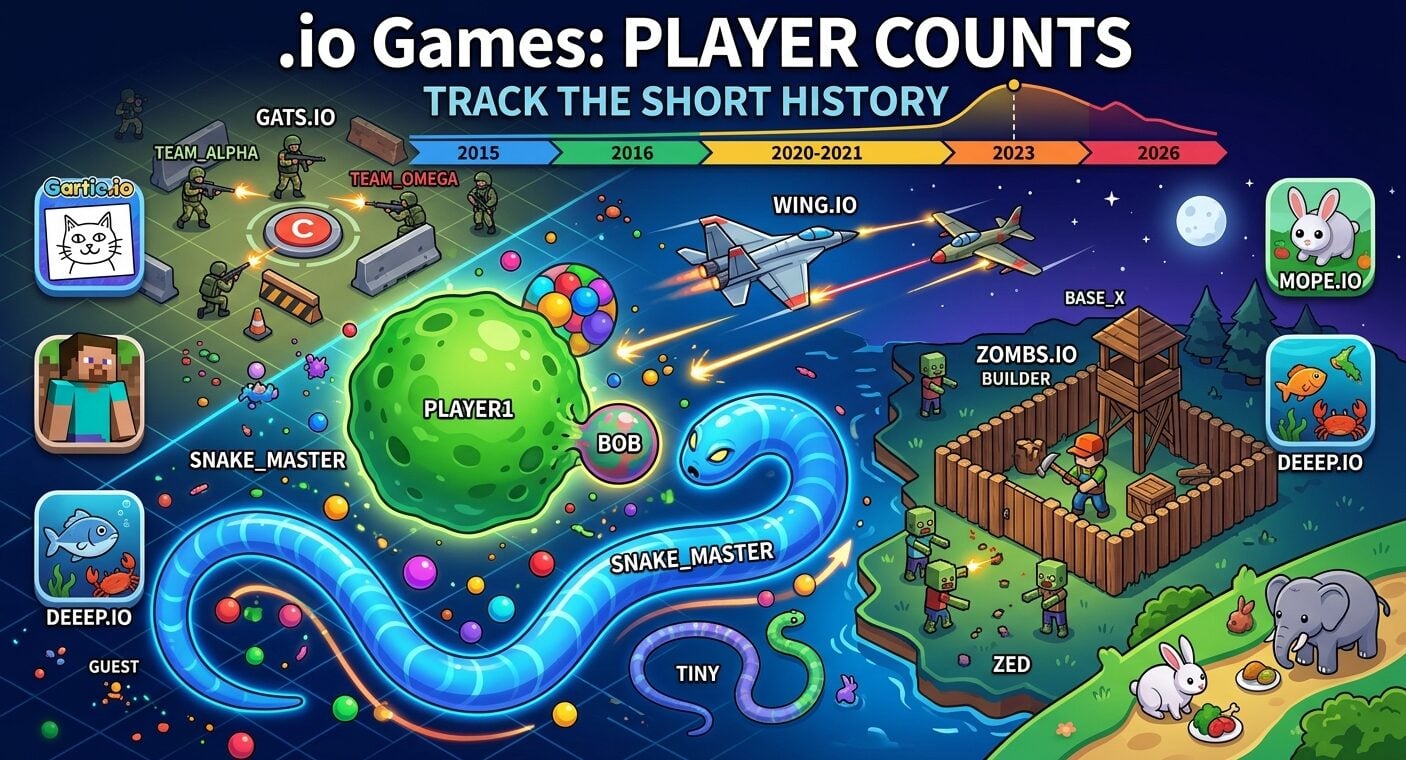
The range runs from Gartic.io, a laid-back charades-style drawing game, to Zombs.io, where players build bases and gather resources by day and fend off zombie hordes at night.
Wings.io sends players into 2D dogfights between fighter planes, Deeeep.io lets them evolve into fish and other animal forms, and Diep.io offers modes from free-for-alls to team battles. Gats.io, a top-down military shooter, adds team deathmatch and control point modes.
Portals that collect the genre now sort it by style as well as by title. Poki has a variety of io games with more than 35 free titles in five common styles. It groups together runs from agar-style and snake games to racing, 3D shooters and Minecraft-style worlds.
Headcount Is Only Part of the Picture
Each of these games is built around other people being in the same match. A sudden jump in players can look like growth without being growth, and the more telling signals are returning-player rates and how session length changes over time.
What the Post-2021 Slowdown Looks Like?
.io games became popular during the peak of the COVID-19 pandemic from 2020 to 2021 because they were easy to access on the web. After 2021, their popularity generally declined, owing to a lack of updates and the rise of traditional mobile and video gaming.
Server lists show what that can look like. Mope.io used to have well over 14,000 players, and a return visit in 2024 found few to no players on any of its servers, with lag problems and a lack of updates blamed for the drop, before 3AM Experiences took the game over in August 2024 and began updating it again.
Surviv.io, which Kongregate acquired in December 2019, was shut down in March 2023, before returning on Kongregate’s own site in 2026.
A single return visit is one person’s observation, not a count, and it says little about how many players any given .io game has on a given day.
For a format built around shared rounds, whether players keep coming back may be the clearer sign of whether a game is still active.
