
Swiss Stage: The Field After Each Round
By Alex╺
- PS4
- PS5
- XBox One
- Series X
- PC
A Swiss stage looks like a pile of matches with no bracket behind it. It has a shape, and most of that shape is settled before the first map loads.
Sixteen teams, five rounds, eight places on the other side. How many teams sit on each win-loss record after each round is decided by the pairing rule rather than by any of the results.
How a Swiss Stage Pairs Its Matches?
A Swiss stage puts every team against a team on the same record. Nobody goes out on a first loss, and nobody plays a schedule drawn up in advance.
The idea comes from chess, where it has been in use for more than a century. Two rules carry the whole format: participants are paired with others on the same score, and no two of them ever meet twice.
Round one splits the field in half. Eight teams come out at 1-0 and eight at 0-1, and from round two onwards those halves stop meeting each other.
The Swiss Stage Format Has Two Exits
Chess plays a set number of rounds and then counts the points. Esports changed the ending. In the version the majors use, teams play until they hit a set number of wins or losses rather than a set number of games.
Three wins take a team out of the stage upwards. Three losses take it out downwards. Everybody else is still in, on a record somewhere between those two.
So a Swiss stage has no fixed length for any one team. It has a fixed length for the field, because no record can run past 3-2 or 2-3.
The Swiss Stage Field, Round by Round
Group sizes do not depend on who wins. Pairing by record on a field of sixteen forces the same distribution every time the format is run.
After round one it is 8 and 8. After round two it is 4 teams at 2-0, 8 at 1-1 and 4 at 0-2. After round three, two teams are through at 3-0, two are out at 0-3, and the twelve still playing split evenly, six at 2-1 and six at 1-2.
The chart has the rest.
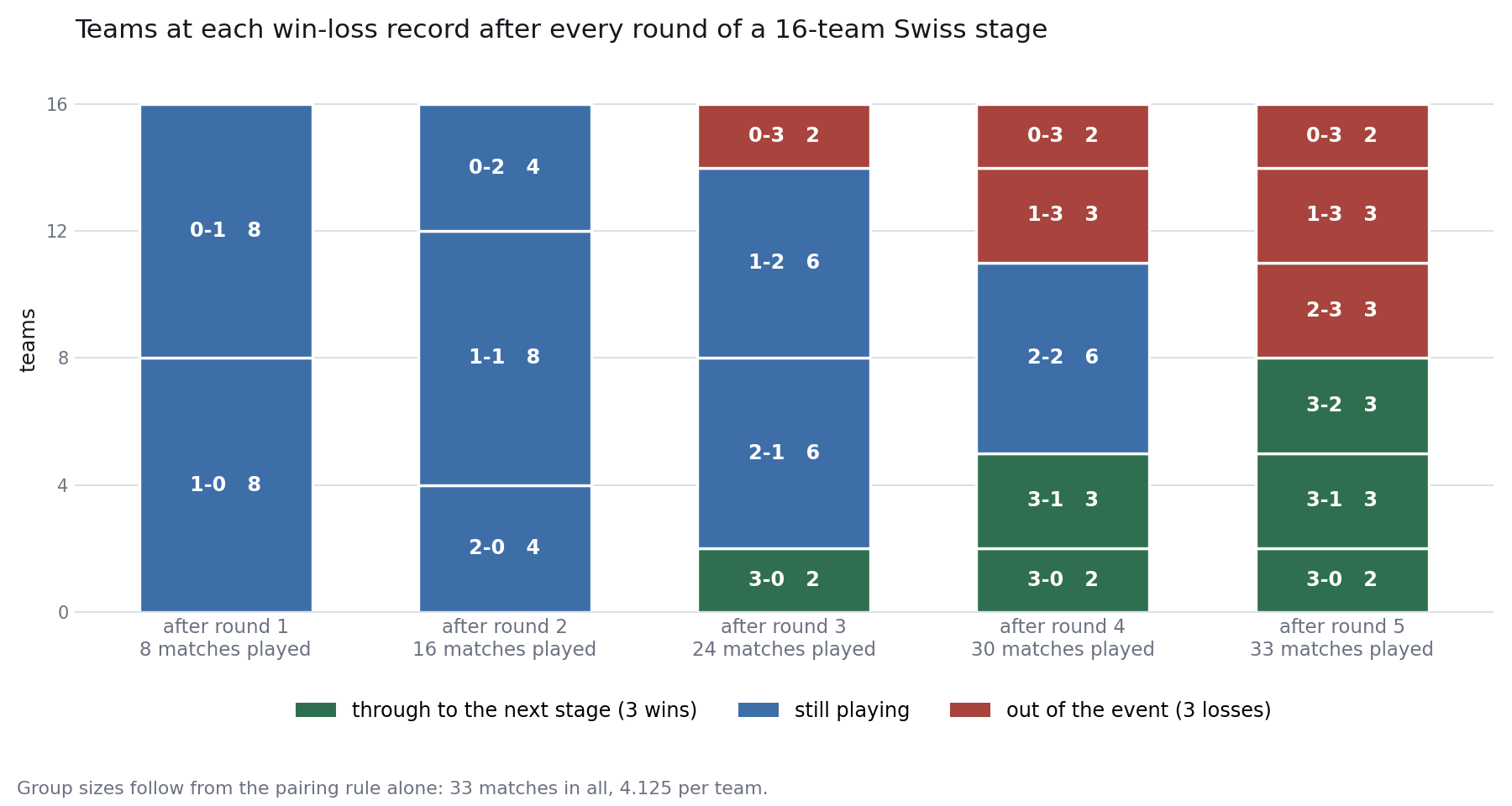
Two teams are through and two are out before round four is drawn.
Round four sends three teams through at 3-1 and three home at 1-3. Round five splits the last six, three up at 3-2 and three out at 2-3, so eight advance, eight go home, and 33 matches are played to sort them.
Round Three of a Swiss Stage Puts Equals Together
Round three is where the pairing rule bites hardest. The 2-0 teams meet each other with qualification on the line, and the 0-2 teams meet each other with elimination on it.
A Swiss-round match settles the way any other match does, with one winner and one loser. That two-way shape is what a reader meets when checking a match against the esports board on OVERDOG, where the matches are grouped by title. Every price on it is put up by another bettor, and the venue itself takes no side of the result.
Matches on that board carry a match winner market beside map or game winner, map and series handicap, totals and, where they are listed, objective props.
A shared record is not a shared level, but it does mean two sides have won the same number of matches inside the same event. That is more common ground than two teams usually bring to a match.
Seeding Inside a Swiss Stage Record Group
Sitting on 2-0 does not say who a team plays next. Inside a record group the order comes from how hard the wins were.
Ties inside a group are broken the way chess breaks them, by adding up the results of the opponents each side has played. Counter-Strike’s majors run the same idea as a difficulty score, counting an opponent’s wins and taking off their losses. A side on 2-0 that beat two 1-1 teams ranks above a side on 2-0 that beat two 0-2 teams.
In the early rounds the top seed of a group then draws the lowest available seed that does not repeat a fixture. So the pairing carries a second fact beyond the record, which is the schedule each side has already come through.
Three Matches or Five in the Same Stage
Teams do not all play the same amount. Four of the sixteen are finished after three matches, six play four, and six go the full five. The rounds shrink as the stage runs: eight matches in each of the first three, six in the fourth, three in the last, for running totals of 8, 16, 24, 30 and 33.
Those 33 matches are two teams apiece, so a team plays a shade over four of them. Two of sixteen finish 3-0 and two finish 0-3, which is 12.5% of the field at each end, while 37.5% of it needs all five matches before the stage lets it go.
Five rounds in a week therefore produce far more matches than a knockout of the same size, and the format has already matched the sides in most of them. Stages of this shape run several times a season on the titles that draw the most betting attention.
Backing the Same Shape Event After Event
None of this is a one-match opinion. The 2-1 group and the 1-2 group throw up the same kind of pairing in event after event, so anybody who reads them well backs the same shape of ticket week after week. The habit is the one that reads the economy inside a single round rather than the scoreline.
A sportsbook writes each of those tickets against its own book, so an account that keeps beating it turns into a bill the book would rather not pay. The usual fix is a ceiling on what that account is allowed to stake.
That question does not come up on the board above, where the money opposite a ticket was staked by somebody who wanted the other result.
The tenth ticket in a stage is charged like the first, by a 1% cut for OVERDOG that never moves plus whatever Polymarket charges on the order itself. Nothing on that route cuts an account for winning, and how large a ticket can get depends on the stakes other people have already placed on the other result.
What a Swiss Bracket Shows Before Round Four?
Three things are settled before round four is drawn, and none of them needs a view on how good the teams are. The size of every record group is fixed, the teams in it are known, and the order inside it comes out of arithmetic anybody can repeat.
Standings go up between rounds at the events that pull the biggest crowds, so the reading can be done while the previous round is still being played.
Round one is the only round a Swiss stage pairs on seeding alone. Everything after it pairs on what the teams have done inside the event, which is a shorter and far more relevant record than any preview carries. Five rounds of that hand the last matches to the teams the stage could not separate.
