
The Gamification of Waiting: Why Unlocking a Chest Feels Better Than Receiving Cash
By Alex╺
- PS4
- PS5
- XBox One
- Series X
- PC
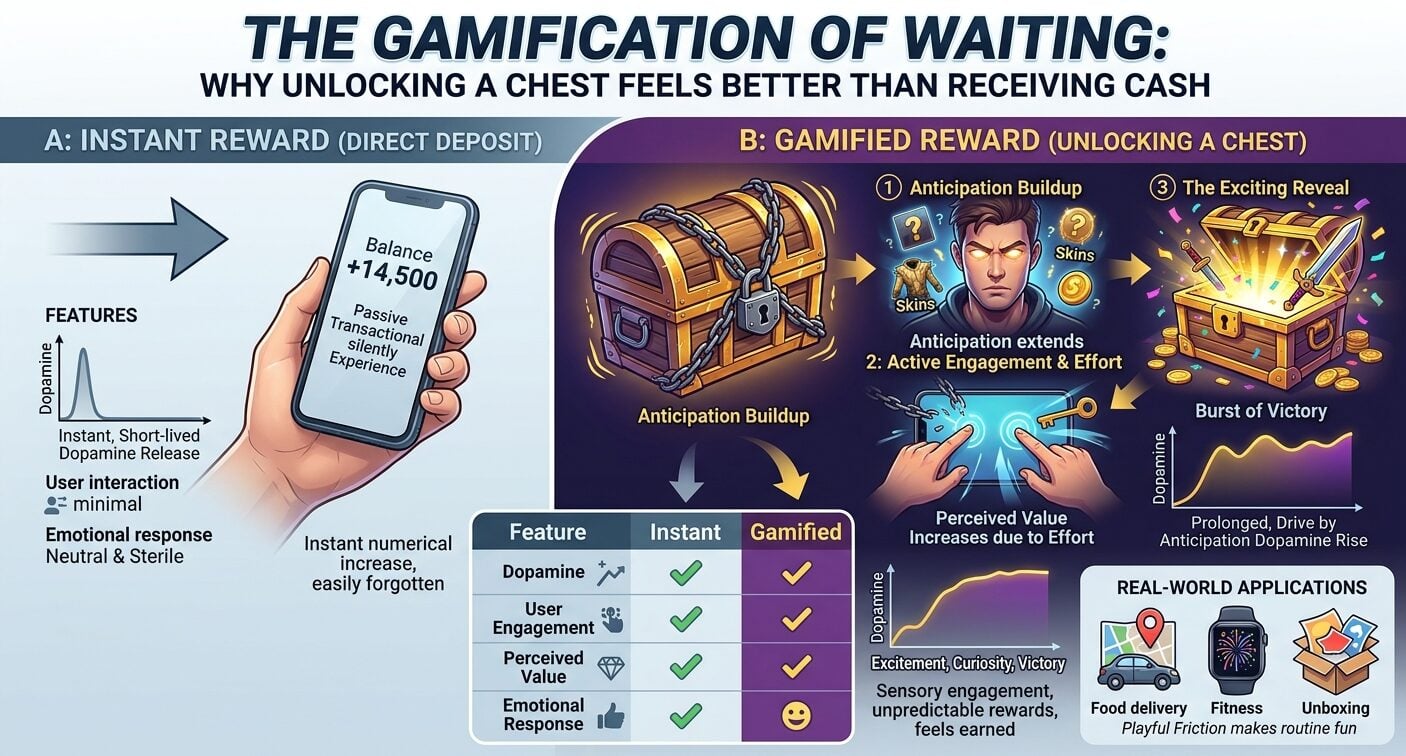
We live in a world where instant results are the norm, yet software designers intentionally slow down the moment of payoff.
When an app presents a locked treasure chest instead of instantly updating your balance, it taps directly into your brain’s reward system. This deliberate pause builds tension, making the final reveal far more satisfying than a simple cash deposit.
The Psychology Behind the Delay
Why do we prefer a drawn-out reveal over instant gratification? The answer lies in dopamine. Often mislabeled as the pleasure chemical, dopamine is more closely tied to anticipation and motivation. Research on reward prediction shows that it rises when we expect a reward, not just when we receive it.
By adding a waiting period or an interactive element to a basic transaction, developers extend this phase of anticipation and keep users engaged longer.
When a prize is granted instantly, the excitement is brief and easily forgotten. When it is hidden behind a locked door or a mystery box, the brain stays excited for longer.
Three psychological triggers make delayed gratification effective:
- Anticipation buildup: The seconds before a chest opens let your brain cycle through possible outcomes, raising the emotional stakes and making the payoff feel bigger.
- Variable rewards: Unpredictability keeps the experience fresh, a pattern psychologists have studied since B.F. Skinner’s work on variable reinforcement.
- Effort justification: Waiting for a timer or tapping a screen takes a little effort, and people tend to value what they worked for, so the prize feels earned rather than handed out.
Together, these triggers explain why a short delay can feel more exciting than an instant payout.
Why a Chest Beats a Direct Deposit?
Imagine completing a task and instantly seeing a number increase on screen. It is efficient, but sterile and boring. Now imagine that same task rewarding you with a glowing, rattling crate that takes three taps to break a heavy iron lock.
The value inside might be identical, but perceived value rises sharply because the process engages your senses, emotions, and curiosity.
This principle turns routine moments into highlights across many kinds of entertainment. Unlocking a rare skin in a mobile RPG feels special because the game makes you watch the crate crack open.
In online casinos, the same idea shapes how rewards are delivered, and one FS Casino bonus, the Wheel of Fortune, swaps the chest for a spinning wheel, letting players use participation points to spin for free spins or small cash credits instead of simply watching their balance change.
As with any casino bonus, though, the terms matter as much as the animation, so read the wagering rules before you play.
The table below sums up how the two approaches differ:
| Feature | Instant Reward | Gamified Reward |
| Dopamine Release | Short-lived | Longer, driven by anticipation |
| User Engagement | Passive and transactional | Active and highly interactive |
| Perceived Value | Purely numerical | Enhanced by sensory experience |
| Emotional Response | Neutral and flat | Excitement, curiosity, and victory |
The reward itself may be the same, but the experience around it is not.
Elements That Make Waiting Fun
To make a wait enjoyable, designers rely on specific sensory and interactive components. Without carefully tuned elements, a delay just feels like technical lag. When done well, however, these delays become the most thrilling part of the experience.
Visual and Audio Cues
The presentation of a reward is often as important as the reward itself. Vibrating chests, glowing particle effects, and a rising musical crescendo tell your brain something important is happening.
These sensory inputs create a miniature story. Users move from curiosity to high tension, ending in a burst of confetti when the item is revealed.
The Illusion of Control
Many chest-opening mechanics require an action, such as swiping a virtual key or tapping the screen. This interaction creates a strong illusion of control, a bias psychologist Ellen Langer described in the 1970s.
Even though an algorithm decided the contents, starting the opening sequence yourself makes you feel personally responsible for the outcome. This small physical action bridges the gap between screen and user, deepening the emotional connection to the prize.
Real-World Applications Beyond Gaming
The idea of making waiting more fun has spread from video games into everyday consumer services. Companies have found that playful friction can noticeably improve customer satisfaction, even during dull chores or financial transactions.
Consider how these common services use gamification to make waiting more enjoyable:
- Food delivery tracking: Instead of a static estimated time, apps show a tiny car moving across a live map, turning the hungry wait into something to watch.
- Fitness milestones: Smartwatches do not just quietly log steps; they wait until you hit a target to trigger a buzz and a burst of animated fireworks, turning a routine walk into a celebration.
- E-commerce unboxing: Premium brands design physical packaging to open in stages, so customers peel back layers of tissue paper and stickers before seeing the product, much like a real-life treasure chest.
Each example uses the same trick: a short, entertaining delay that makes the result feel like a reward.
The Future of Interactive Rewards
As apps compete harder for our attention, the way they deliver achievements will continue to evolve. A plain exchange of points or cash is often not enough to keep people engaged. By turning the act of receiving into a small game of its own, developers hold user interest, boost satisfaction, and turn routine interactions into memorable moments.
Next time you stare at a bouncing, glowing treasure box, think about the psychology behind it. You are not just waiting for a prize; you are taking part in a carefully designed loop that shows the journey is often more thrilling than the reward itself.
