
Why Startups Fail More Than They Succeed
By Alex╺
- PS4
- PS5
- XBox One
- Series X
- PC
Every year, thousands of founders launch companies with confidence, a pitch deck, and a belief that their idea is different. A few years later, many of those businesses no longer exist.
The gap between ambition and survival is one of the most consistent patterns in entrepreneurship, and it rarely comes down to one dramatic mistake.
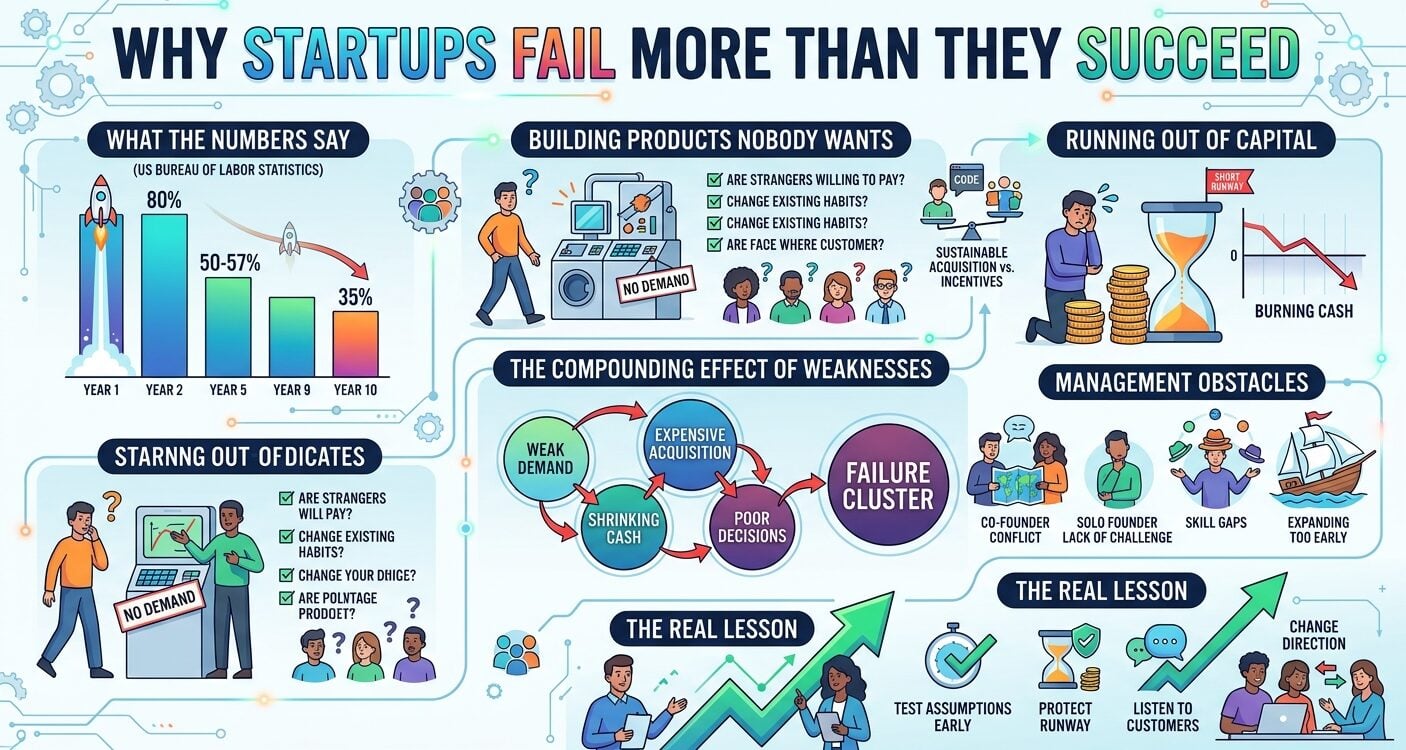
Startups usually fail because several weaknesses—limited demand, expensive customer acquisition, shrinking cash reserves, or poor decisions—begin reinforcing one another.
What the Numbers Say About Startup Survival Rates?
The often-repeated claim that nine out of ten startups fail is difficult to verify because investors, founders, and statisticians define “failure” differently. A more useful benchmark comes from US Bureau of Labor Statistics data on private-sector business establishments.
Broadly, the numbers show that around four in five new establishments survive their first year, roughly half remain after five years, and about one-third are still operating a decade later.
| Time Since Launch | Approx. Share Still Operating | Approx. Share Closed |
| 1 year | About 80% | About 20% |
| 5 years | Around 50–57% | Around 43–50% |
| 10 years | About 35% | About 65% |
These figures cover businesses more broadly, not only venture-backed technology startups. That distinction matters because venture-funded companies are usually expected to grow much faster.
For venture-backed businesses, pressure to scale quickly can narrow the range of acceptable outcomes. A small but profitable company may be perfectly successful for its owners while still falling short of the returns expected by a venture fund. Whatever the funding model, however, business closures tend to cluster around several recurring problems.
Building Products Nobody Actually Wants to Buy
Poor product-market fit remains one of the most important reasons startups struggle. Founders sometimes fall in love with a solution before confirming that the problem is common, urgent, and important enough for customers to pay to solve.
The danger is that weak demand can initially look like success. Friends praise the idea, early adopters provide enthusiastic feedback, and a small group of users creates the impression of a much larger market.
The real test begins when the company tries to sell to strangers at a price that covers its costs. Before scaling, founders should be able to answer a few uncomfortable questions:
- Are strangers willing to pay rather than simply say they like the product?
- Is the problem important enough for customers to change existing habits?
- Can customers be acquired for less than their long-term value?
- Do users return without constant discounts or incentives?
- Is the market large enough to support the planned growth?
If several of these answers remain unclear, scaling can amplify the weakness rather than solve it.
Customer acquisition is where unrealistic assumptions often become visible. Competitive digital businesses frequently use incentives to lower the barrier to registration.
For example, online casinos are one example, with offers such as a slotoro promo code designed to attract new users. For a startup, the crucial question is whether the revenue generated by each customer can sustainably exceed the cost of acquiring and serving them.
Running Out of Money Before the Business Model Works
Capital problems are closely connected to weak demand. When customers arrive more slowly than expected, revenue targets slip while salaries, software, marketing, and other expenses continue.
Recent startup post-mortem analyses have repeatedly identified running out of capital as one of the most common reasons companies close.
Poor product-market fit, bad timing, and weak unit economics often contribute to that outcome rather than operating as separate problems.
Founders can make the situation worse by treating spending as proof of progress. Hiring quickly, leasing larger offices, or increasing advertising may make a startup look as though it is scaling, but those decisions also increase monthly burn.
The important number is runway: how long the company can continue operating before its available cash is exhausted. If the next funding round takes longer than expected or revenue disappoints, a business with high fixed costs has very little time to adapt.
Why Founders and Teams Become Their Own Obstacle?
Markets and money receive most of the attention, but management problems can be just as damaging. Common founder and team issues include:
- Co-founder conflict: Disagreements over equity, strategy, workload, or decision-making can become especially damaging when the company is already under pressure.
- Lack of challenge: Solo founders may have fewer people willing to question weak assumptions or push for a change in direction.
- Skill gaps: Technical founders may struggle with sales, while commercial founders may misjudge what the product team can realistically build.
- Expanding too early: Entering new markets before the first one is stable can stretch both capital and management attention.
None of these mistakes necessarily destroys a company on its own. The real danger comes when several appear at the same time while cash reserves are already thin.
The Real Lesson Behind Startup Failure Rates
Startup failure is rarely caused by one spectacular decision. More often, small problems compound: weak demand makes customers expensive to acquire, expensive acquisition reduces cash reserves, falling cash creates pressure to raise funding, and that pressure encourages rushed decisions.
The businesses that survive are not necessarily the ones that begin with the most impressive idea. They are often the ones that test assumptions early, protect their runway, listen to customers, and change direction before a manageable problem becomes a fatal one.
