
3D Art Outsourcing for Games: How Studios Scale Production Without Losing Quality
By Alex╺
- PS4
- PS5
- XBox One
- Series X
- PC
A mid-sized mobile game can ship with a few hundred 3D assets, and a console title can need thousands: heroes, enemies, weapons, buildings, rocks, foliage, vehicles and the variants of each.
Very few studios keep enough modelers, texture artists and riggers on staff to cover the peaks of that workload without long idle stretches afterward.
That gap is the reason external art teams became a normal part of game production rather than an emergency measure.
Many developers now plan 3d art outsourcing from pre-production onward, handing a partner whole asset categories while the internal team keeps ownership of art direction and core gameplay.
Set up well, the arrangement adds capacity without diluting the look of the game. Set up badly, it produces a folder of models that need rework before anyone can import them.
What studios typically hand to an outside 3D team?
The work that moves to external artists tends to be the work with clear inputs and measurable outputs. If a concept sheet, a polygon budget and a target engine exist, an asset can be produced anywhere.
Characters and creatures
Character production is the most common request and the most demanding one. A typical hero goes through a high-poly sculpt, retopology into a game-ready mesh, UV unwrapping, baking of normal and ambient occlusion maps, and texturing in either a PBR or a hand-painted style.
Each step has its own failure points: bad edge flow around shoulders and knees shows up only once the model is rigged and starts to bend. Teams that outsource characters usually keep the concept and final approval in-house and hand over everything between them.
Environments, props and modular kits
Environment work is high in volume and repetitive by design. Instead of modeling every building by hand, artists build modular kits (walls, floors, corners, trims) that snap together on a grid, plus tileable textures and trim sheets that keep memory use under control.
Props fill the space between them: crates, weapons, furniture, vehicles. Background props are a classic first outsourcing task because the specs are simple and a mistake costs little.
Rigging, animation and effects
Rigging is often booked as a separate service, especially for creatures, vehicles and anything with mechanical parts. Animation follows: locomotion cycles, attacks, idles and cinematic shots. Effects artists build particle systems in tools such as Unity’s VFX Graph or Unreal’s Niagara for spells, explosions and weather.
When animation is outsourced, the client usually shares the skeleton and a clip list first, so the delivered animations plug into the existing character controller without retargeting.
3D for slot and casual games
Slot and casual projects use 3D differently. Characters and symbols are often modeled and lit in 3D, then rendered out as image sequences or sprite sheets so they run on any device, including in a browser. The artist still models in 3D, but the deliverable is 2D frames that must match the game’s palette and frame budget.
Some teams also render characters in separate parts and animate them in Spine, which keeps file sizes small for web builds and lets one model serve several win animations.
Why developers outsource 3D production?
Capacity that follows the schedule
Art demand on a game project is uneven. Pre-production needs a handful of concept artists and one or two technical artists to set standards. Full production can need several times that many people for a year or more, then the number drops again during polish and live operations.
Hiring and onboarding a 3D artist usually takes months, and letting people go after a peak damages a studio’s reputation. An external team absorbs the peak and steps back when it ends, which keeps the internal headcount stable.
Access to narrow specialties
Some skills are needed for a few weeks per project: facial rigging, hard-surface vehicle modeling, stylized hair, destruction setups, or a technical artist who can rebuild a shader for low-end Android devices.
Keeping these specialists on payroll all year rarely makes sense for a small or mid-sized studio. A partner that runs several projects at once can keep them busy and bill only for the hours one project uses.
Predictable costs
Outsourced 3D is usually priced per asset, per milestone or as a dedicated team billed monthly. Any of these pricing models turns the cost of art into a number a producer can plan against, instead of salaries, equipment, software licenses and office space.
Time zones can also help: a team several hours ahead can pick up feedback in the morning and deliver revisions before the client’s day starts.
How an outsourced 3D pipeline runs?
Most experienced vendors follow a similar sequence, with a client sign-off at the end of each stage. The checkpoints matter more than the exact tools, because each one catches problems while they are still cheap to fix.
- Brief and references: concept art, turnarounds, mood boards and a style guide.
- Technical specification: engine, triangle budget, texture resolution, naming rules, pivot and axis orientation, export format.
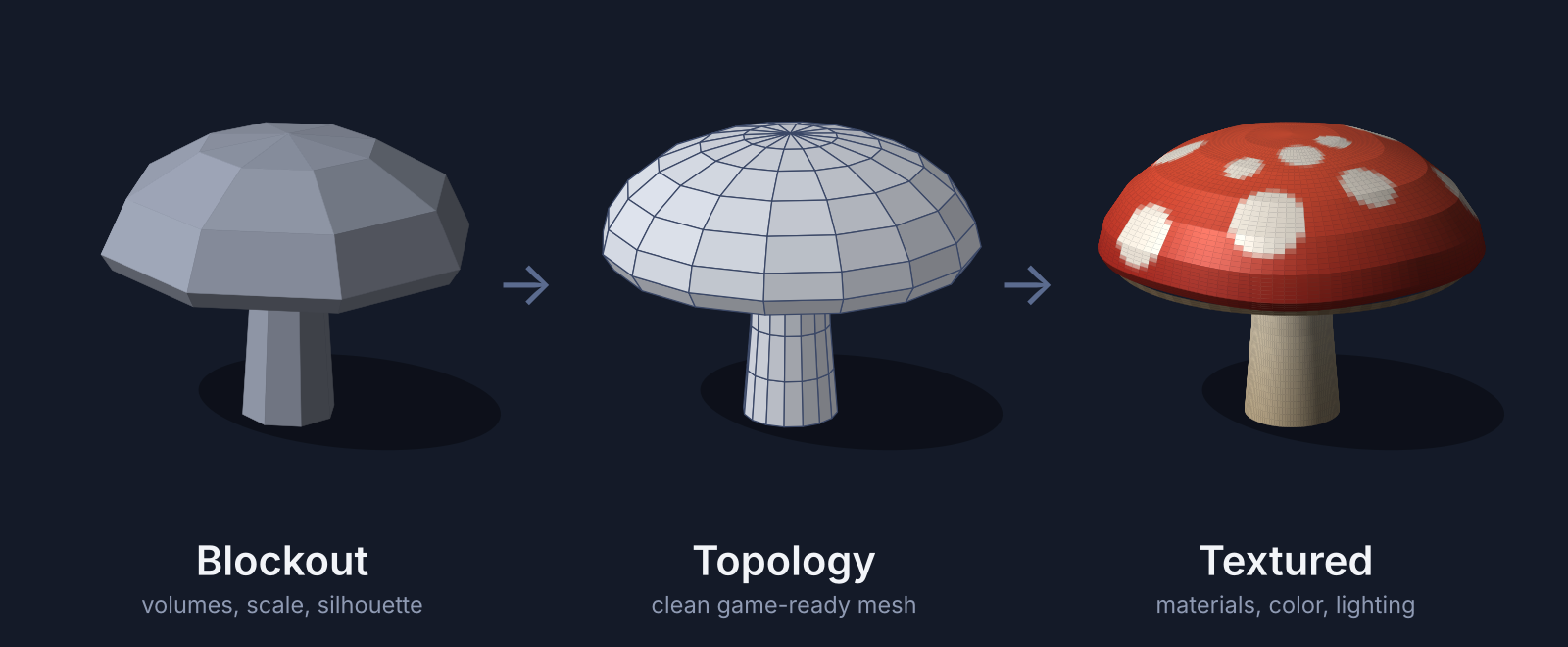
- Blockout (greybox): rough volumes placed in the engine to check scale and silhouette.
- High-poly sculpt or hard-surface modeling, depending on the asset.
- Retopology, UV unwrapping and map baking.
- Texturing in the agreed style, PBR or hand-painted.
- Rigging, skinning and animation tests for anything that moves.
- Technical QA and engine import: LODs, collision, naming and a review under the game’s own lighting.
Technical specs come before the first polygon
The second step is the one teams skip most often, and the one that causes the most rework. A sword modeled at 12,000 triangles for a mobile game with a 3,000-triangle prop budget has to be rebuilt, however good it looks. A one-page spec sheet per asset type, agreed before work starts, prevents most of these surprises.
It should list the engine version, budgets per asset class, texel density, material setup, file naming and how deliveries are packaged.
How to choose a 3D art partner?
A polished portfolio is the starting point, not the deciding factor. Beauty renders hide topology, texture efficiency and how a model behaves in a real engine. Before signing, it helps to check the following:
- Wireframes, UV layouts and texture sheets for shipped work, not only final renders.
- Range of styles, and whether one of them is close to your game.
- Experience with your engine and platform, since mobile draw-call limits and console memory budgets call for different habits.
- A named project manager, a shared task tracker and a few hours of overlap in working time.
- Contract terms covering NDA, transfer of intellectual property and access to your builds or repositories.
- A pricing model that fits the project: per asset for small batches, a dedicated team for long production.
Run a paid test task
A short paid test tells you more than any sales call. Choose one asset that represents the real work, such as a mid-complexity character or a modular wall set, and send it with your actual spec sheet.
Then judge the result on three things: does it import cleanly into your engine, does it match the style guide, and how does the team handle the first round of feedback? A vendor who asks good questions before starting is usually the one who needs fewer revisions later.
Mistakes that cost the most time
Review mistakes
A model can look finished in a marketing-style render and still break in the game: wrong scale, flipped normals, missing LODs, or materials that look flat under the game’s lighting. Every delivery should be checked in a test scene inside the actual engine before anyone approves it.
When a client approves only the final model, a proportion problem found at that stage can mean redoing the sculpt, the retopology, the UVs and the textures. Approving the greybox first takes a day and can save a week.
Communication mistakes
If the art director, a producer and two designers all send notes separately, the vendor receives conflicting instructions and usually tries to satisfy all of them. One person on the client side should collect, filter and send feedback in a single list per round.
Large projects sometimes split work between two or three outside studios. Without a shared style guide, reference models and a common texel density, the assets from each team look slightly different when placed side by side. The fix is a small set of approved “golden” assets that every vendor matches.
Final thoughts
Outsourcing 3D art works best when the external team is treated as part of the production rather than a supplier of files. The studio keeps the vision, the style guide and the final say; the partner brings the hands, the specialists and the process.
Clear specs, early checkpoints, a single feedback channel and reviews inside the engine solve most of the problems people associate with outsourcing. With those in place, a small team can ship a game with the visual scope of a much larger one.
